EU summit: Draghi calls for two-speed Europe to move faster. El título no debe incluir ningún
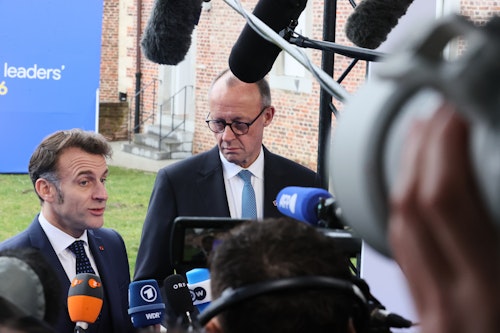
The 27 EU leaders have gathered for a full-day retreat focused on finding new ways to revive the bloc’s stagnant economy, abolish regulatory barriers and attract investment in the face of competition from the US and China.
Former Italian Prime Minister Mario Draghi, who authored an influential report on competitiveness, called on leaders to explore the use of enhanced cooperation to “move faster” in smaller groups of willing member states, an EU official said.
Enhanced cooperation was last used in December to issue a €90 billion loan to Ukraine without the participation of Hungary, Slovakia and the Czech Republic.
Earlier this week, Ursula von der Leyen, the president of the European Commission, embraced the prospect of a two-speed Europe to break the political deadlock.
Germany, France, Spain, Belgium, Denmark and Ireland have also voiced support.
Follow our live blog for regular updates.
Why is everybody talking about enhanced cooperation?
An obscure tool from the EU treaties is suddenly en vogue.
The keyword of today’s informal summit is enhanced cooperation, a legal provision that allows a smaller group of member states to adopt common initiatives on their own, without endangering the EU’s overall policy. It has been used only sparingly in the past to create the European Public Prosecutor’s Office (EPPO), introduce a unitary patent and harmonise divorce law.
The mechanism, enshrined in Article 20 of the Lisbon Treaty, requires a minimum of nine member states to be activated and leaves the door open for others to join at any time. For example, the Netherlands, Malta, Sweden and Poland signed up to the EPPO at a later stage.
Enhanced cooperation unexpectedly made the front page in December, when EU leaders activated the workaround to issue a €90 billion loan to meet Ukraine’s military and financial needs for 2026 and 2027. As part of the backdoor deal, Hungary, Slovakia and the Czech Republic opted out. This means the interest from the loan will be paid by 24 member states, rather than the usual 27.
Earlier this week, Ursula von der Leyen, the president of the European Commission, openly floated the possibility of using enhanced cooperation on a wider scale to advance economic reforms where consensus proves unreachable. The leaders of France, Germany, Spain, Denmark, Belgium and Ireland, as well as Mario Deaghi, have expressed support for the strategy, signalling serious momentum.
“The first try always needs to involve the 27 member states, but we’re not going to tie our hands down,” said a senior EU official. “If we see there’s a critical mass of countries willing to move forward, I think that should be looked at in the same pragmatic way.”
Swedish PM backs more simplification and trade agreements
Swedish Prime Minister Ulf Kristersson told reporters there was “a tendency to talk about extremely long-term things instead of talking about what is low-hanging fruit.”
Kristersson said he supported the EU’s simplification efforts and the signing of more trade agreements, as well as “things that give economic effect to Europe in an immediate way.” The EU has the reputation of “talking too much” and “doing too little,” he added but “when we’re at our best, we get things done too.”
.
Kristersson also welcomed the trade agreements with Mercosur and India and pushed for stronger commercial partnerships, while urging the European Parliament not to postpone Mercosur’s ratification.
Austrian Chancellor’s 5-point plan to guide the EU’s future
Austrian Chancellor Christian Stocker is presenting a 5-point plan to boost competitiveness in Europe to his counterparts, according to a document seen by Euronews.
The document identifies five key target issues for the EU to address. Here is the text of the crucial section:
- Energy prices & market design: If the EU is serious about competitiveness, it must start with energy prices. Reviewing the merit order and decoupling gas and electricity prices, extending free certificates and adjusting the Green Deal.
- Europe first: Upcoming major projects and procurements, e.g. in critical infrastructure or the reconstruction of Ukraine, must specifically benefit the European economy.
- Fair competition – an end to the Austria surcharge. Against price discrimination in smaller markets. It is absolutely unacceptable that consumers in Austria pay more for the same products than people in larger neighbouring countries.
- Deepening the internal market and capital markets union: With 450 million consumers, the EU is one of the largest and strongest markets in the world. But there is still much potential to be tapped here by removing barriers and solving cross-border problems. This is because bureaucratic hurdles still act as de facto customs barriers. Around €300 billion flows out of the EU every year. In order to keep European money in Europe and invest it in domestic companies and innovation, the capital markets union must be further expanded.
- Fair trade policy: In this changing world, we as the EU must seek out additional partners and broaden our base. Ambitious free trade agreements (e.g. India, Australia, UAE, ASEAN) are the key to success if the EU wants to be a resilient and strong player on the global stage In addition, common EU protection mechanisms against unfair market practices and third-country interventions must be expanded. Only together can we protect our interests in Europe.
Mario Draghi made the case for a two-speed Europe
Mario Draghi, the former prime minister of Italy, who authored a highly influential report on competitiveness, called on EU leaders to explore the possibility of a two-speed Europe to “move faster” in the most urgent areas to revive the economy, an EU official said after Draghi left the room.
Draghi’s presentation at the informal summit “highlighted the deterioration of the economic landscape since he presented his report and the urgency to address all the issues he raised at that time,” the official explained. His address focused on the need to eliminate barriers in the single market, mobilise private savings, lower energy prices and establish a “targeted” European preference in public contracts.
Draghi floated the possibility of using enhanced cooperation, which allows a smaller group of member states to launch separate initiatives, to break the deadlock and achieve results. Enhanced cooperation was last used in December to issue a €90 billion loan to Ukraine without the participation of Hungary, Slovakia and the Czech Republic. It was the first time the legal tool was used for foreign policy.
“What followed was a very substantial exchange of views with the leaders,” said the EU official.
Leaders to debate EU trade diversification
EU leaders will use today’s talks to zero in on how to diversify trade as geo-economic tensions with China and the US intensify.
Trade deals are the core of the Commission’s strategy, with Brussels accelerating negotiations with partners across the globe. The US accounts for 20.6 per cent of EU exports and China 8.3 per cent, meaning more than 70 per cent of shipments go elsewhere – a figure the Commission sees as an opportunity to reduce dependence on Washington and Beijing.
Brussels recently sealed free trade agreements with India and the Mercosur bloc, and is aiming to wrap up talks with Australia, the United Arab Emirates and ASEAN countries. EU Trade Commissioner Maroš Šefčovič is set to meet Australian Trade Minister Don Farrell on Thursday.
Agriculture remains a sticking point. Already a major hurdle for the Mercosur deal signed in January, it is a source of friction with Australia, which is seeking greater access for its beef and lamb exports than the EU is currently willing to grant.
Germany and Italy, keen to shape the summit’s outcome, are pushing for an ambitious trade agenda. Nordic and Baltic countries, along with the Netherlands, want the Mercosur agreement implemented swiftly.
France, by contrast, remains a staunch defender of its farmers and is reluctant to further open the agricultural market to foreign competitors.
Slovenian PM backs ‘Made in Europe’ production
Slovenian Prime Minister Robert Golob said “we need realism” to deliver the European preference touted by France and backed by European Commission President Ursula von der Leyen.
The Slovenian PM said that the “Made in Europe” principle is being developed by EU countries that want to “go faster” and that Slovenia is “inclined to this proposal”.
“They do not need to blockade individual states to stop the development of all of us,” Golob said.
‘We need giant leaps’ – EU Parliament President Metsola
“Small steps won’t cut it where we need giant leaps. We need more than a piecemeal quick-fix adjustment, and this can make a real difference“, European Parliament President Roberta Metsola told the assembled EU leaders at their retreat.
While she supports the 28th regime for European businesses proposed by former Italian Prime Minister Enrico Letta, she considers it far from enough.
“We now need to complete the Savings and Investments Union by the end of the year. That’s the message our industries need, and the message Europe must send to the world,” she said.
Metsola used her speech to insist on four priorities for the EU: completing the single market, simplification, investment and trade. On each, she outlined the state of play of files in the Parliament, claiming it “will continue to deliver.”
“Where possible, we should buy European. But where not, we shouldn’t sacrifice our industries that depend on external resources under the illusion of self-reliance.”
‘Germany and France aligned on competitiveness,’ Merz says
German Chancellor Friedrich Merz said that while no official decision is expected to come out today, EU leaders share a tacit agreement on competitiveness and the completion of the European market.
“We want to make this European Union faster, we want to do it better, we want above all to ensure that we have a competitive industry in Europe,” Merz said.
He said the attendance of former Prime Ministers Enrico Letta and Mario Draghi will be essential to talk about competition and the European market.
“I am happy that Emmanuel Macron and I, as always, are in agreement about these questions,” Merz said, contradicting reports of fundamental differences between the two leaders on the EU’s future.
“I expect we will take a step forward today without making decisions, but we are preparing decisions to be made in four weeks,” Merz added, referring to the formal Council Summit next month.
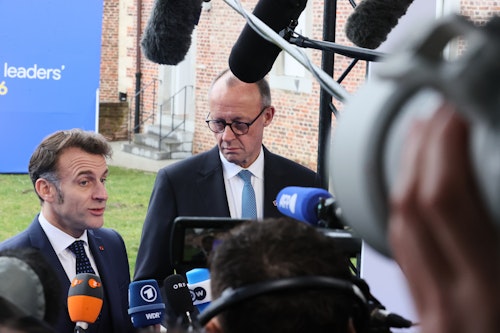
Take a look inside the media centre
While leaders gather at the Alden Biesen castle, journalists are huddled in a tent built nearby. Among them: Euronews’ Jorge Liboreiro and Peggy Corlin.
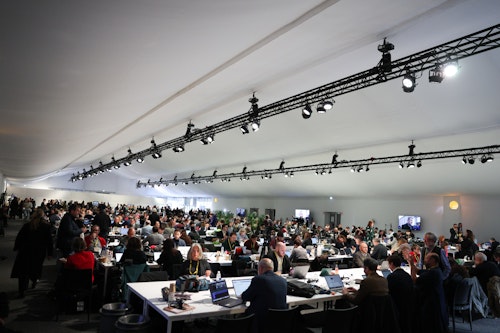
What is Draghi’s “pragmatic federalism”, the idea to break the EU deadlock?
Former Italian Prime Minister and President of the European Central Bank Mario Draghi outlined his idea of “pragmatic federalism” in a speech at the Belgian KU Leuven University on February 2.
He is convinced that, given the current geopolitical circumstances, the European Union should become “a genuine federation”, to avoid deindustrialisation and decline.
“Power requires Europe to move from confederation to federation”, he said, as the current EU institutional architecture does not produce power.
“A group of states that coordinates remains a group of states – each with a veto, each with a separate calculus, each vulnerable to being picked off one by one”.
But merging EU States into a federation would require changing the EU treaties, which requires unanimity, a clearly unachievable target nowadays. So Draghi proposes a different approach, called “pragmatic federalism,” to break the deadlock. Some countries that are willing to do so can unite in the domains where progress can currently be made.
“Member states opt in. The door remains open to others, but not to those who would undermine common purpose”, Draghi said, pointing to the adoption of the euro as the “most successful example” of this dynamic.
“Those who were willing went ahead, built common institutions with real authority, and through that shared commitment, forged a solidarity deeper than any treaty could have prescribed. And since then, nine more countries have chosen to join.”
Draghi acknowledges that not all countries will join every initiative from the outset, whether in energy, technology, defence, or external policy. But he also believes that the old divisions that have paralysed the EU so far have now been overtaken by a common threat. Without building a European federation, in his opinion, EU countries will remain vulnerable and condemned to decline.
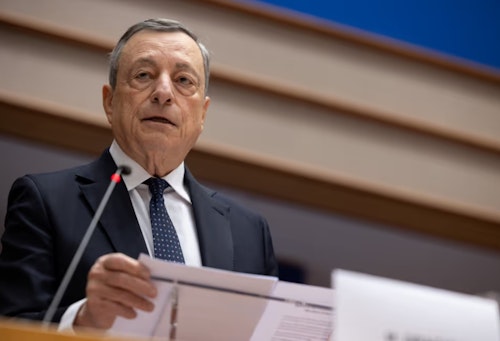
Draghi session over, leaders head for lunch
The morning session with Mario Draghi, the former prime minister of Italy who authored a highly influential report on competitiveness, has come to an end. The discussion focused on geo-economics, the global forces that put pressure on the European Union’s growth and prosperity.
EU leaders have now gone for lunch.
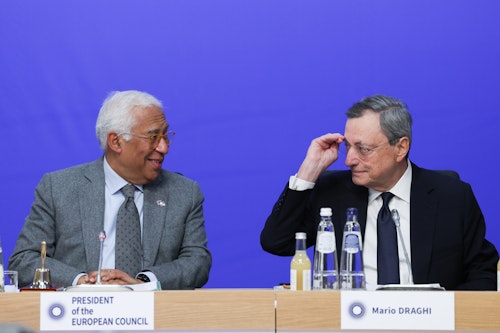
‘One of the most important EU summits,’ Christodoulides says
“I consider this summit as one of the most important ones in the European Union,” Cypriot President Nikos Christodoulides told reporters, saying today’s gathering is similar to the EU summit held last year to discuss defence and security.
“I hope that today it will lead to specific decisions with timetables. So that we can strengthen the EU’s competitiveness, which we all agree on,” the Cypriot leader said.
Cyprus, which currently helms the EU Presidency, has made clear that one “basic priority” is to strengthen Europe’s autonomy.
“We cannot talk about the strategic autonomy of the European Union without being strong in the issue of competitiveness,” Christodoulides said.
The Cypriot President said he’ll meet the Greek Prime Minister Kyriakos Mitsotakis to discuss the discussions he held with the President of Turkey, with hope and expectations for the island’s reunification on the rise.
Christodoulides also said he will have discussions with Mitsotakis to find a “joint approach” regarding US President Donald Trump’s invitation to join the controversial Board of Peace.
“We will discuss with the Mediterranean states so that we have a common approach in relation to the participation level. We always talk about the part that concerns gas,” he said.
A two-speed Europe is needed to unblock Europe, Danish Prime Minister says
Danish Prime Minister Mette Frederiksen said that a two-speed Europe is the right way to proceed, answering a reporter’s question on the topic.
“If you had asked me five or ten years ago, I would have said no,” Frederiksen said. “Now you ask me today, and then I would say yes. […]”
“Several can block Europe from doing what is right for Europe and I think we will see governments that are pro-Russian and that are in reality against Europe”, she said, adding that it is unacceptable that “we do not do what is needed for Europe because of one country or two.”
Frederiksen’s comments reflect the firm proposals put forward by French President Emmanuel Macron and European Commission President Ursula von der Leyen to advance a multi-speed EU. In a letter circulated before the summit, von der Leyen suggested that member states ready to act on economic issues should move forward in smaller groups if consensus cannot be reached at the EU level.
‘Energy costs have to go down’, Chancellor Stocker says
“The prioritisation is clear to me, the energy costs have to go down,” Austrian Chancellor Christian Stocker said, dubbing it a “crucial question”.
Stocker is also keen about prolonging the free allowances under the EU’s carbon market, a hot topic currently under discussion as the European Commission is due to revise the European Trading System (ETS) by the summer.
Stocker also said fair and free trade should be key priorities for the European Union.
«It’s about fair trade and free trade, about new agreements with India, Indonesia, but also with the United Arab Emirates,” Stocker said.
The Chancellor said today’s informal gathering will help to prepare “concrete decisions” for the formal Council in March.
Giorgia Meloni: ‘There is a German-Italian engine nowadays in Europe’
Italy’s Prime Minister Giorgia Meloni acknowledged that a German-Italian “engine” is currently driving momentum.
“There is for sure a convergence with [German] Chancellor [Friedrich] Merz on many topics,” Meloni told reporters ahead of today’s informal summit. “We are strengthening our bilateral cooperation, but this does not mean we are excluding someone else,” she said.
Meloni and Merz have advocated for deregulation and appear to be forming a new axis poised to steer the leader’s negotiations. “At this stage, there is a revival in relations and in the capacity that Italy and Germany are showing to coordinate their positions,” Meloni said. “The Chancellor’s role has been very positive—very positive indeed—and I am grateful to Friedrich because we are doing a very good job together.”
The Italian Prime Minister described the discussion at the pre-retreat “coordination meeting,” a new format she is promoting to present “concrete ideas” for debate during the leaders’ summit. ” I want the Council to give the Commission clear things to do, and that the Commission uses this mandate to curb red-tape”.
There was no discussion on eurobonds at the pre-retreat meeting, Meloni said, but she told reporters that she expected the issue to come up at the summit. “This is one of the big issues that Europe has been discussing for some time, and on which you know that there are very different positions,” Meloni said.
The most urgent priorities to address at the moment are the energy prices, with a much-needed stop to financial speculation, the completion of the single market, and the simplification of European legislation, she added.
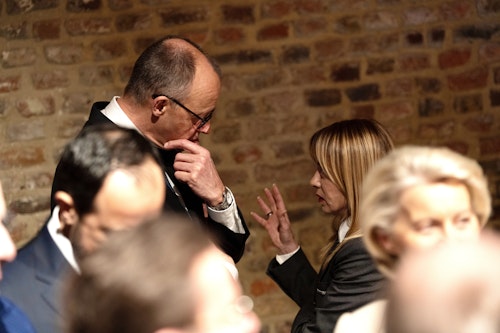
Pre-retreat coordination meeting focused on completion of the single market, reduction of energy prices and EU trade policy
Italian Prime Minister Giorgia Meloni, German Chancellor Friedrich Merz, and Belgian Prime Minister Bart de Wever hosted the inaugural meeting of a new informal working group dedicated to issues of European competitiveness before the start of the leaders’ summit, according to diplomatic sources.
Alongside Italy, Germany, Belgium, and the European Commission, 16 other countries took part in the meeting: Austria, Bulgaria, Cyprus, Croatia, Denmark, Finland, France, Greece, Luxembourg, the Netherlands, Poland, the Czech Republic, Romania, Slovakia, Sweden, and Hungary.
The leaders’ discussion focused on the three priorities outlined in a document prepared by Italy, Germany, and Belgium: the completion of the Single Market; the regulatory simplification and reduction of energy prices; and EU trade policy, which was defined as “ambitious and pragmatic”.
The debate touched upon the initiatives necessary to relaunch Europe’s industrial base, starting with a rapid review of emissions taxation mechanisms (ETS and CBAM), as well as the need to ensure swift and faithful follow-up to the political priorities identified by the European Council.
The leaders agreed to meet again on the sidelines of the next European Council, in March, in order to keep a strong focus on competitiveness and to define concrete objectives and clear deadlines for the EU.
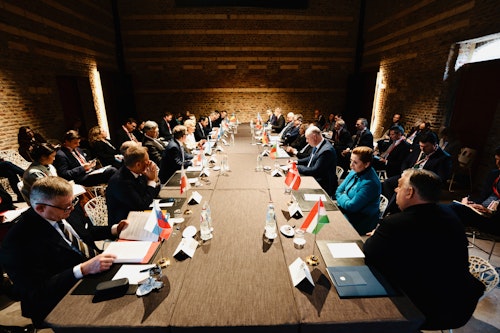
‘We need to deepen the domestic market and raise private capital,’ Frieden says
Luxembourgish Prime Minister Luc Frieden said it’s important EU governments agree on the way forward to “deepen the domestic market”.
“We have the domestic markets, but it is still very difficult for small and medium-sized companies very difficult to invest beyond the borders,” he said.
He also suggested the bloc needs to move faster to get private capital on top of public money in European investments.
“These are our goals and the method has to be improved. We can not only talk, but we also have act. We have to act faster,” he said. “We have set goals and data: in five months, we are there; in ten months, we’re there. And that is what I want to bring to this Council today.”
Macron: we need to ‘go fast’
French President Emmanuel Macron urged Europe to “really go fast” on competitiveness and take “concrete decisions” to present at the European Council in June.
The French president reiterated some of his main priorities – including his “made in Europe” and two-speed Europe plans.
The priority, he told reporters, is to “implement everything that we agree on” and “go much faster” on regulatory simplification, expansion of the single market and energy costs.
A European preference will be crucial, he said, “on some sectors that are particularly under threat”.
‘Simplify, simplify,’ says Luxebourgish PM Frieden
Luxembourgish Prime Minister Luc Frieden said today’s informal meeting is as much about competitiveness as it is about jobs.
“If we don’t have jobs in Europe anymore, our social model will fall apart. And that’s why it’s so important to me that we produce more in Europe, but that we also give the opportunity to companies so that they can produce in Europe,” Frieden said, suggesting an alignment with French-backed “Made in Europe” proposals.
“And that is why you have to simplify, simplify,” Frieden said, adding that companies cannot continue to be burdened with administrative tasks.
De Wever: energy cost is main priority
Belgian Prime Minister Bart De Wever acknowledged that France and Germany take different viewes when it comes to the “Made in Europe” concept.
“Everybody agrees,” on the need to protect the European market, de Wever said. “How do we do this? It’s another issue.” De Wever made clear he was hopeful that “we can reconcile the two.”
The Belgian Prime minister also insisted that the main concern today was about energy costs, which he said are putting European industries “in mortal danger”.
Europe is “not competitive” and risks losing its petrochemical industry but also its steel and metals, he warned – “and of course if you lose that you have no strategic autonomy anymore”.
De Wever also recommended that the commission come up with proposals on competitiveness “every month” and that competitiveness should be on the agenda of every council meeting.
Mario Draghi enters castle without speaking to reporters
Former Italian Prime Minister and President of the European Central Bank Mario Draghi refrained from speaking at his arrival at the Alden Biesen castle.
Draghi is a special guest at today’s leaders’ retreat, along with Enrico Letta. Both have penned separate highly influential reports on the European economy.
Macron and Merz meet ahead of informal talks
French President Emannuel Macron and German Chancellor Friedrich Merz are meeting bilaterally before joining EU leaders for informal talks, according to the Elysée Palace.
Prior to the retreat, Germany and France have taken opposing views on fundamental issues, from Eurobonds to European preference. The two leaders addressed a press briefing together, each speaking in his own language.
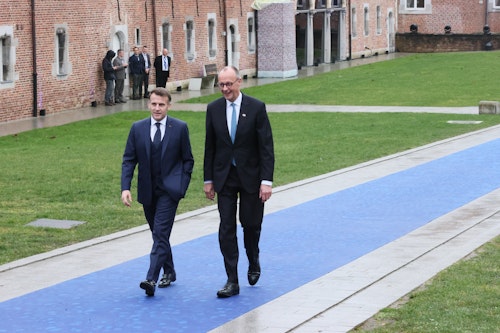
‘Competitiveness needs capital,’ Metsola says
“We have savings in Europe. This is not a question of a lack of it, but we don’t have enough tools to turn them into growth,” Metsola told reporters.
If Europe can manage that through innovation, she said, it can scale up and lower prices.
The European Parliament leader cited new Eurobarometer data indicating that citizens across all countries cited the cost of living and affordability as their top concern.
“All our actions need to be geared toward addressing that as well. We don’t do that. We lose our legitimacy and we lose our credibility. Therefore, we need to complete the Savings and Investments Union. The European Parliament is very much onto that from a legislative perspective.”
‘We’ve always been in favour of integration,’ Metsola says
European Parliament Roberta Metsola said a “two-speed” Europe should be the way forward to further integration, which the Maltese politician doesn’t see as an “obstacle to unity” but rather a “pathway”.
“I don’t think we have any choice as we prepare for what will be the decisive actions to be taken at the March European Council,” Metsola said. “We also need to be ready to make decisions if countries want to go further together.”
Orbán wants to boost competitiveness by cutting Ukraine funding
Hungarian Prime Minister Viktor Orbán told journalists upon arriving at the leaders’ retreat that the European economy is in a downturn, outlining what he described as a three-step solution.
“We need peace, because during war the economy is blocked and cannot grow. War is bad for the economy, so we have to achieve peace as soon as possible,” Orbán said.
He added that part of the solution would be to stop supporting Ukraine in its self-defence against Russian aggression.
“If you have money – and the EU does – you should not send it elsewhere if you still need it yourself. For example, don’t send it to Ukraine,” Orbán said.
His also focused on securing cheaper energy for Europe.
“The main problem for our companies is the price of energy, so we need to lower it. We need to cut prices.”
Orbán’s comments come as Hungary enters an intense phase of its electoral campaign ahead of the parliamentary elections in April, in which the government is being challenged by the opposition Tisza Party.
The government’s main focus has been opposing Ukraine’s potential accession to the European Union, arguing that it would bring instability and economic decline to Europe.
Last weekend, Prime Minister Orbán said that Ukraine was an “enemy of Hungary,” citing Kyiv’s calls for Budapest to reduce its reliance on Russian energy.
‘I’m a liberal, I don’t believe in protectionism’, Kallas says, shunning ‘Made in Europe’
Asked whether she would back the European preference or “Made in Europe” concept being pushed by France, Kaja Kallas rejected the idea, saying she’s a liberal and such idea would amount to protectionism.
“In the longer term, I think it’s best for our companies if they can freely export and if we make ourselves stronger, then our products are also competitive, and we don’t need the protectionism,” Kallas said.
“Saying that, we also have to deal with the economic coercive practices that come from China that greatly damage our companies,” she added
‘We are strong, but need to be stronger,’ Kallas says
“Today we’re going to discuss competitiveness and of course that is the basis for all,” EU High Representative for Foreign Affairs Kaja Kallas told reporters.
“If you want to be a geopolitical power, you’re either a strong economic power or strong military power. We are strong economic powers but we need to be stronger, that’s for sure,” Kallas said, referring to the changing geopolitical landscape.
The EU foreign affairs leader said for this to happen, EU leaders need to “work with our simplification processes”.
“We need to work with everything that’s helpful for our companies,” she said.
Referring to a defence ministers’ meeting on Wednesday, Kallas said that ramping up defence production and a fragmented capital market were flagged as the major obstacles.
“Definitely there’s something that we need to work with and also to build partnerships. To diversify our trade portfolios.”
Andrej Babiš: ‘We need to unify energy market’
Czech Prime Minister Andrej Babiš insisted on the need to unify the energy market in the EU to harmonise the prices of energy across the member states, when he arrived at the Alden Biesen castle.
“In France, they subsidise energy and they pay until the end of the last year €50. In the Czech Republic, we pay €110. So we have to have a unified energy market. This is the only solution”, Babiš said, saying he had a two-hour dinner yesterday with French President Emmanuel Macron.
The Czech Prime Minister pushed back when asked by reporters about eurobonds.
“It’s not about eurobonds, it’s about the cost of energy”, he said.
Latvia PM hails the ’28th regime’ as a ‘good opportunity’ for Europe
Latvian Prime Minister Evika Silina hailed today’s informal gathering as a “good opportunity” to discuss the “European market and competitiveness”.
“I believe we have to give more freedom for our companies to go on without so much bureaucratic burden because we should allow our companies to develop their technologies, to go with their start-ups,” Silina told reporters.
The Latvian prime minister, alongside German Chancellor Friedrich Merz, signed a letter addressed to the European Commission urging EU governments to reduce bureaucracy.
“And now with global markets and our signing of agreements with Mercosur and India, it’s obvious that we need to discuss today how we will go on with our foreign trade, and how the internal markets will look,” Silina said.
She also backed more deregulation and the 28th regime proposal by the European Commission.
“I think it’s a good opportunity for the companies to work on like a pan-european regime and I am really interested to see what the details are about it. We will probably need to discuss. What are the next steps? Should there be some unified taxes, or should there be some more unified issues that we need to decide?” Silina said.
The Latvian leader said it’s a “good opportunity” for Europe to be more digital: “If one company will register themselves in one country, all 27 countries will be needed to approve this business model. So I think that’s a good opportunity for all of us to find a way how we will compete in these global markets.”
Gitanas Nausėda: ‘Shame that that Europe still buys Russian energy’
“It is really a shame that four years after the beginning of the war in Ukraine, we are still talking about our dependencies on Russian energy resources and we are ready to stop by Russian energy resources only next year,” Lithuania’s President Gitanas Nausėda told reporters at his arrival at the Alden Biesen castle.
“My country is doing quite well in reducing those dependencies, and probably you know that my country was first to stop my Russian energy resources a few months after the war in Ukraine broke out,” he stressed.
Nausėda also said that to boost competitiveness and European economy, leaders must talk about expanding the EU’s free trade regimes with other countries.
“I think very good decisions [have been taken] regarding India, regarding Mercosur, regarding Indonesia. Now we have to go forward. Australia, Philippines, and other countries from the region could be in this [list]”, he said.
“It expands our possibilities, and diversifies our export markets. The experience of my country shows that diversification of export markets is the best tool to survive some droughts and economic activity in the region.”
Micheál Martin: ‘We see the necessity of enhanced cooperation’
“We saw evidence [of enhanced cooperation] last Christmas regarding the Ukrainian loan. And we do see the necessity in terms of delivery and getting proposals through the Council,” Irish Taoiseach Micheál Martin told reporters when he arrived at the Alden Biesen castle, adding that “a lot depends on the specifics”.
Enhanced cooperation among some EU member states is being pushed by Commission President Ursula von der Leyen in a letter to EU leaders ahead of the informal summit.
“A deeper savings and investment union ultimately benefits Ireland as well. And we’ve benefited enormously from the single market, so we’re not interfering with enhanced cooperation”, Martin said.
Ireland is in favour of expanding the single market in several areas, particularly in services, and Martin said it is aligned “with a lot of what the Commission is proposing” on the topic.
‘2026 will be the year of competitiveness for the EU,’ Costa says
European Council President António Costa spoke to reporters ahead of the informal gathering in Alden Biesen, outlining the European Union’s main economic priorities for 2026.
“2026 will be the year of competitiveness for the EU,’ Costa told reporters.
Costa highlighted that key priorities include deepening and completing the single market, eliminating internal barriers and red tape, and scaling up European companies as part of the upcoming EU strategy.
“For this, we need to have a vibrant capital market to support our SMEs, our startups, to scale up, to invest in innovation, and to modernise our economies. Second, we also need to scale up our big companies because we need to have strong companies to compete in the global market,” Costa said.
The third priority is to maintain a “very proactive” trade policy, protect companies from unfair competition and economic coercion, and address energy costs, Costa said.
“Today, our priority is to unlock private investment, mobilise our savings to invest in our companies, and to create a more dynamic and vibrant ecosystem for investment,” Costa added.
I look forward to welcoming EU leaders today in Alden Biesen for an informal retreat focused on competitiveness. This brainstorming exercise will help pave the way for a more autonomous Europe and a more resilient economy that delivers for our citizens. https://t.co/J3CkA8Lc3u
— António Costa (@eucopresident) February 12, 2026
Leaders of Italy, Germany and Belgium meet informally, ahead of summit
German Chancellor Friedrich Merz, Italy’s Prime Minister Giorgia Meloni and Belgian Prime Minister Bart De Wever are meeting just now, ahead of the informal retreat.
The three have converged around putting industry at the forefront, less stringent regulation, pragmatic climate targets which is often synonymous with pushing back emissions targets.
Merz rejected Macron’s plan for joint debt.
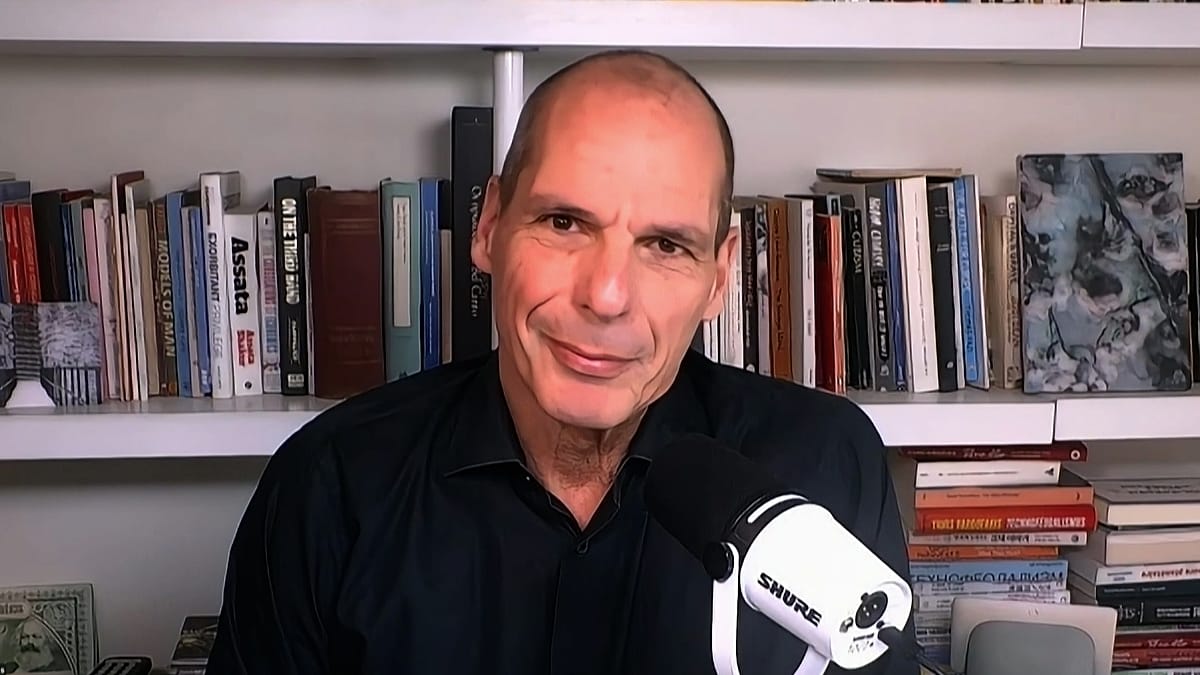
‘Choose to federalise or we can disband the euro’ — Varoufakis
“We have two choices – we are at a fork in the road. We can move in the direction of federation or we can disband the euro,” former Greek finance minister Yanis Varoufakis told Euronews’ Europe Today programme.
The economist argued that EU leaders are pursuing neither path and instead are “falling into the vacuum in between,” as they gather to debate the future of the bloc’s economy.
Watch the full interview by Meabh McMahon here.
Choose to federalise or ‘we can disband the euro,’ Varoufakis says
The former Greek finance minister and economist told Euronews flagship morning show Europe Today that the EU is stuck between federation and disbanding, blamin…
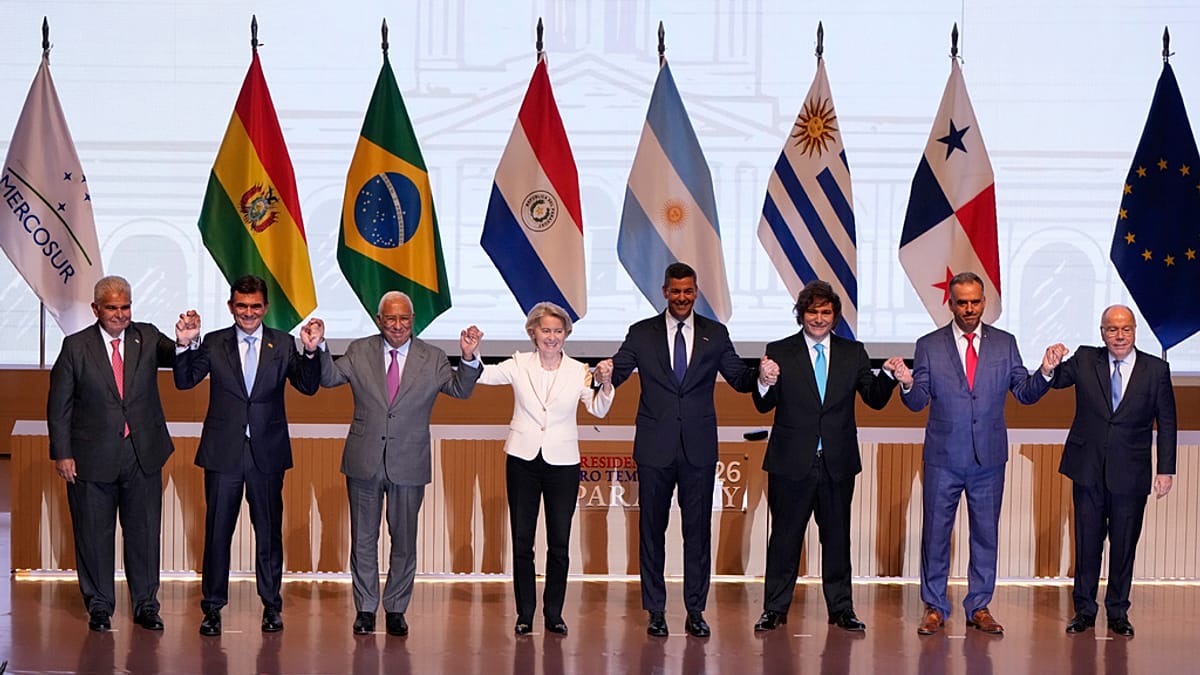
Should the Commission move ahead with provisional application of the Mercosur deal?
As EU leaders debate how to sharpen their trade strategy in the face of mounting US and Chinese competition, the Mercosur trade deal is resurfacing as a key point of contention among member states.
The European Commission plans to consult governments on the provisional application of the pact— a move that would establish a free-trade area between the EU and Argentina, Brazil, Paraguay and Uruguay.
Formal ratification has stalled after Members of the European Parliament referred the agreement to the EU Court of Justice for review.
Supporters of the agreement – including Germany and Spain – are pushing for provisional implementation as global geo-economic tensions intensify.
The deal was signed in January after securing the support of a majority of EU countries.
France remains a staunch opponent, with farmers warning that Latin American imports would expose them to unfair competition.
More about the Mercosur agreement 👇🏽
EU seals contentious trade deal with Mercosur countries
After 25 years of talks, the EU signed the EU-Mercosur trade deal on Saturday, creating a 700 million-person free-trade area. Ratification is still pending, ho…
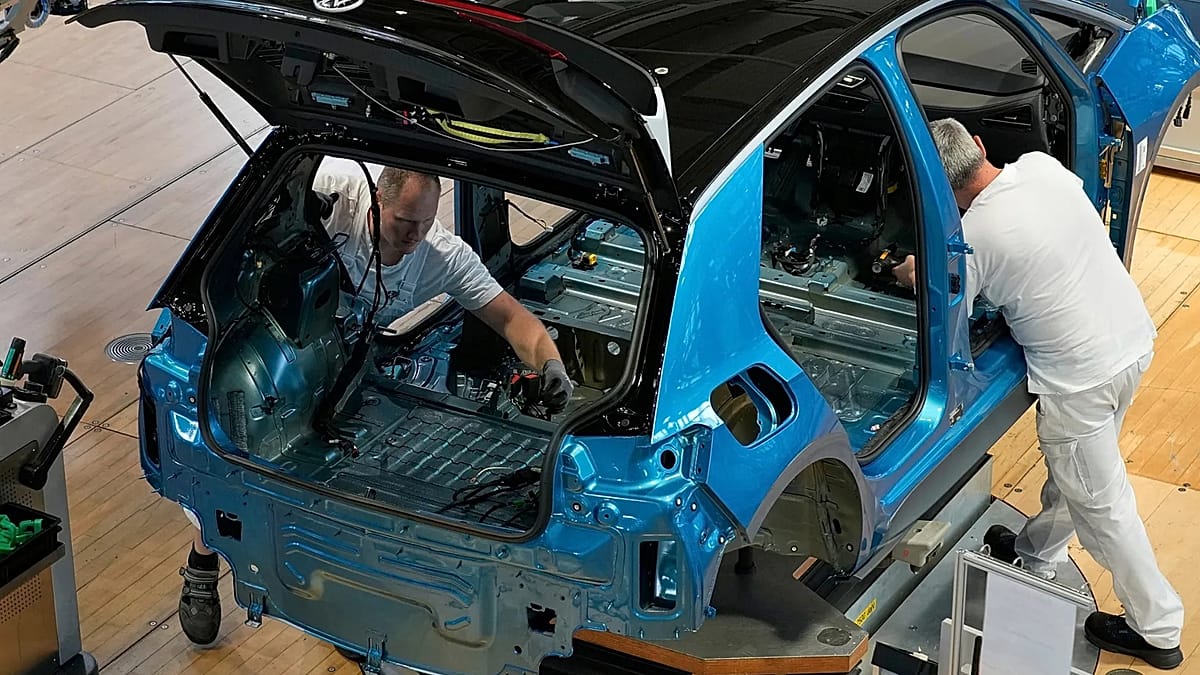
‘European preference is a risk to healthy supply chains’, EU industries say
Industries across the bloc are warning that European preference rules could upend global supply chains – and raising doubts about how such a policy would work in practice.
“We are generally critical of local content approaches, as our supply chains are highly intertwined internationally,” a spokesperson from the German Association of the Automotive Industry (VDA) told Euronews.
“The devil is in the details, in how you frame it,” ASD Europe secretary general Camille Grand told Euronews. “If we think of civil aeronautics, we’re dealing with a highly globalised supply chain. So it is a little different than a domain where the supply chain or the elements are mostly domestic or European.”
Read the full story 👇🏽
‘EU preference is risky to healthy supply chains,’ EU industries say
As EU leaders put “Made in Europe” on their agenda at Thursday’s informal summit, industries across the bloc are warning that European preference regulations c…
France’s ‘Made in Europe’ to dominate EU talks on competitiveness
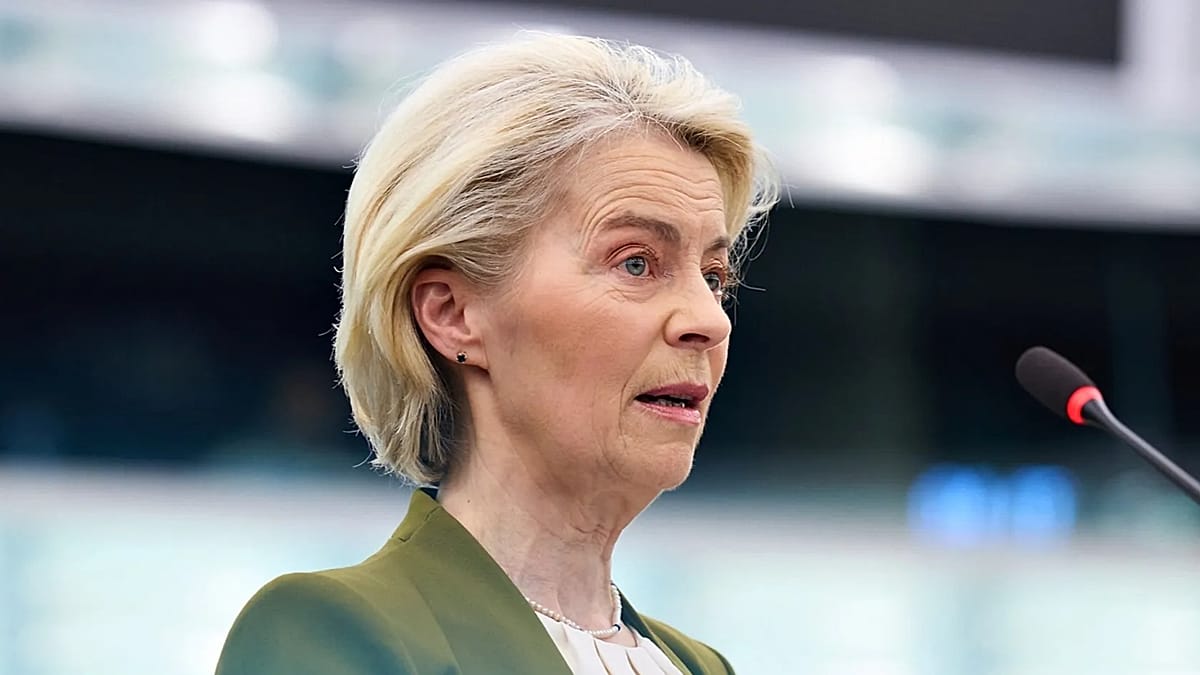
“I believe that in strategic sectors, European preference is a necessary instrument that will contribute to strengthening Europe’s own production base,” Ursula von der Leyen, the president of the European Commission said in Strasbourg on Wednesday. “It can help create lead markets in those sectors and support the scaling-up of European production capabilities.”
“But I want to be clear – it is a fine line to walk,” von der Leyen added. “There is no ‘one-size-fits-all’. That is why every proposal must be underpinned by robust economic analysis and be in line with our international obligations.”
Von der Leyen’s cautious endorsement of “Made in Europe” underscores how politically sensitive the idea has become, gaining prominence in EU debates as the bloc grapples with economic stagnation, punitive US tariffs, and increasingly aggressive Chinese trade practices.
Read the full story by Jorge Liboreiro here.
European preference is a ‘fine line to walk’, warns von der Leyen
The debate on “Made in Europe” will be at the centre of the discussions that EU leaders will have during an informal summit on Thursday. #EuropeNews
France hits German-Italian alliance’s wall
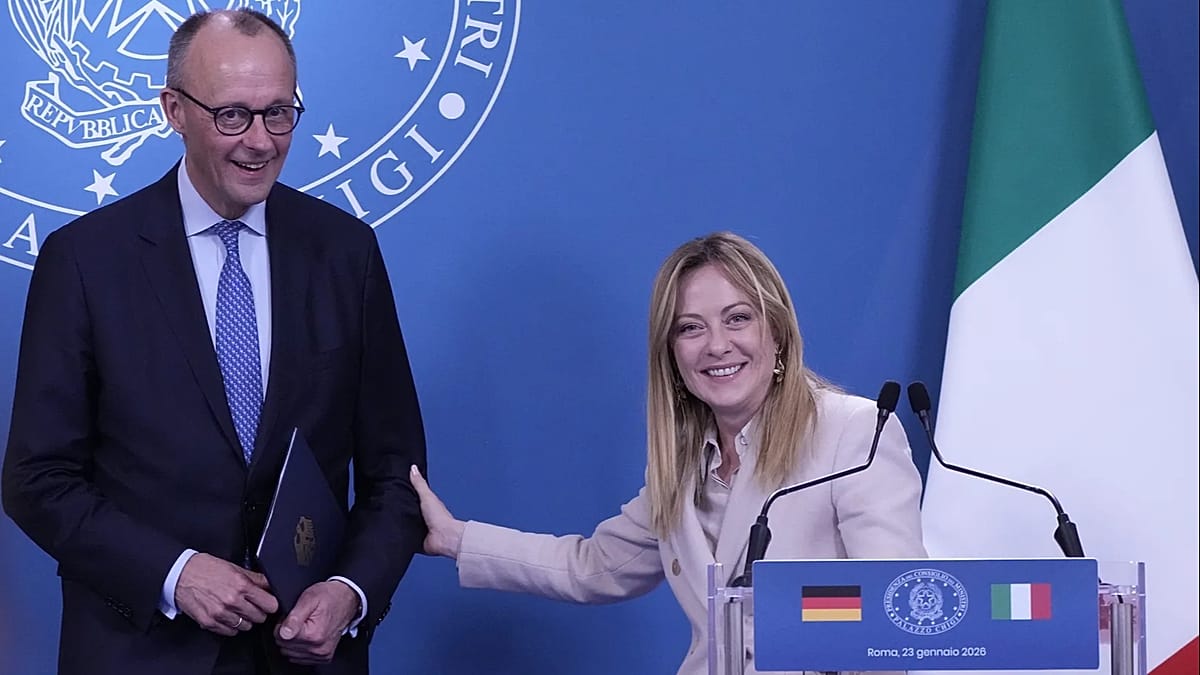
French President Emmanuel Macron is facing a new alliance between German Chancellor Friedrich Merz and Italian Prime Minister Giorgia Meloni as EU leaders clash over how to reignite the bloc’s economy.
From eurobonds and “European preference” policies to the Mercosur trade deal, competing visions are set to collide during leaders’ talks.
France has put one of the most contentious issues back on the agenda: joint EU debt as a tool to support the bloc’s recovery.
Germany and Italy are expected to call for expanded venture capital financing, improved exit options for investors, and deeper deregulation.
Read the full story by Peggy Corlin here.
France set to clash with Germany and Italy at EU leaders’ retreat
Paris is facing a Berlin-Rome axis in the debate over how to revive the EU economy. From eurobonds to a European preference and the Mercosur trade deal, compet…
‘Made in Europe’ or ‘Made with Europe’?
When EU leaders meet at Alden Biesen Castle on Friday, one idea will loom large over the discussions: “European preference,” more commonly framed as “Made in Europe.”
Yet the bloc remains far from united on what that should mean.
Long championed by France, the idea is simple: EU public procurement should prioritise goods with local content, helping protect the single market from foreign rivals — particularly Chinese companies.
The concept has been gaining traction in EU capitals and within the European Commission. Yet since it surfaced at a meeting of the 27 industry ministers last December, clear divisions have emerged.
Paris is pushing for a strict definition of “Made in EU,” especially in clean tech, steel, autos and chemicals.
“When a French guy says protection, some people want to hear protectionism, but It’s not my political DNA,” French President Emmanuel Macron said on Thursday, adding: “I don’t believe in protectionism, but I don’t believe in such a naive continent where we are the only one in this world not to protect the local producers.”
Berlin, meanwhile, favours a softer approach under the label “Made with Europe,” which would leave the door open to companies from partner countries outside the EU. It would also confine the policy to strategic sectors such as defence and technology – and only for a limited period.
A third group – the Nordics and Baltics, along with the Netherlands – sounded the alarm in a paper circulated ahead of the summit, warning that “Made in Europe” “risks wiping out our [EU’s] simplification efforts, hindering companies’ access to world-leading technology, hampering exchange with other markets and pushing investments away from the EU.”
Von der Leyen listens to industry bosses’ concerns over high energy prices
At their informal retreat in Alden Biesen EU leaders will treat energy not as just another policy area, but as the very bedrock of geopolitical and economic power.
Everything Europe hopes to deliver— industrial revival, digital leadership, AI capacity, re-shoring manufacturing, strategic autonomy — hinges on cheap, secure, controllable energy.
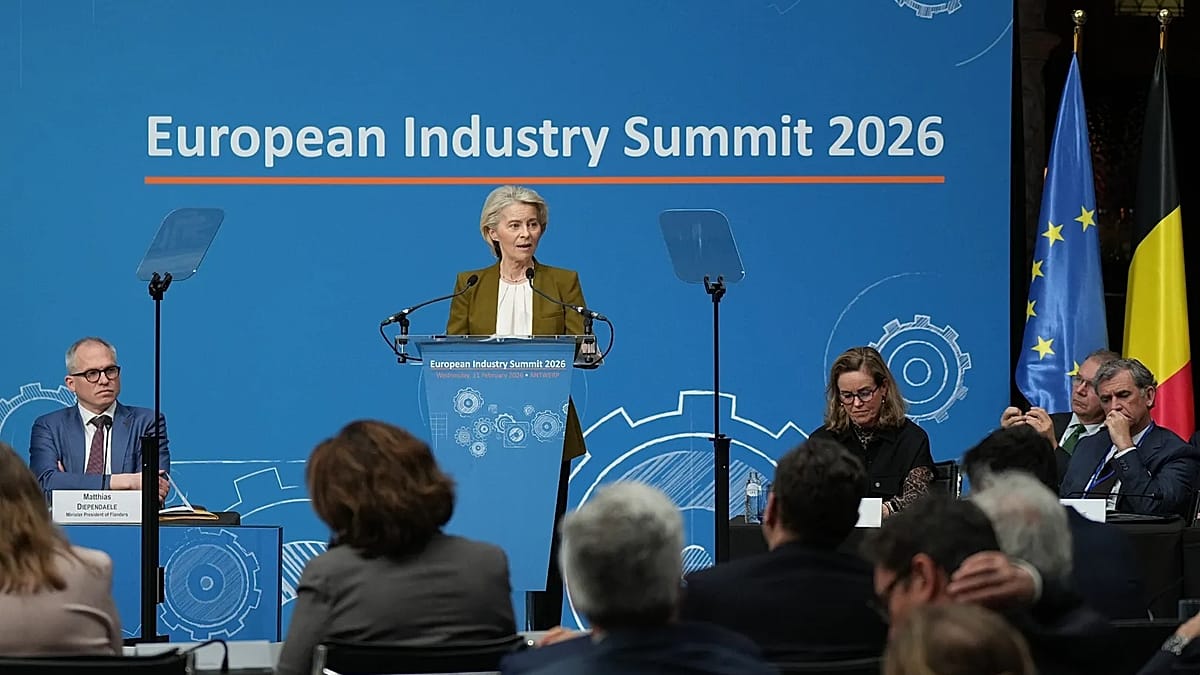
European Commission President Ursula von der Leyen acknowledged the burden of “high and volatile” energy prices on energy-intensive industries during her address to business leaders in Antwerp on Thursday.
“We know the reason for this: gas drives prices up, renewables and nuclear drive prices down. The good news is we are well-positioned to lower costs,” von der Leyen said, adding that improvements to the electric grid will be key alongside offshore wind power projects to be linked to the Danish and German national grids.
Industry bosses call for ‘urgent and bold’ action to cut energy prices
The plea comes ahead of an informal summit in Alden Biesen on Thursday, when leaders will discuss the bloc’s competitiveness and ways to revitalise the economy…
Draghi and Letta: two reports confronting the EU’s existential crisis
The landmark Draghi report, released in September 2024, is taking center stage in today’s discussions among EU leaders meeting in Alden Biesen.
The hefty document highlights the EU’s sluggish growth, weak productivity, and other competitiveness challenges — which Draghi, the former Italian prime minister, bleakly described as a path toward “slow agony.” The solution? Massive investments, a deeper single market, regulatory simplification and more EU financing capacity.
Yet despite the urgency of Draghi’s message, only one in 10 of the proposed measures has been implemented, according to the European Parliament’s research department. German Chancellor Friedrich Merz and Italian Prime Minister Giorgia Meloni have become two of the most outspoken champions of Draghi’s agenda — calling for faster action on the reform roadmap.
Former Italian Prime Minister Enrico Letta also published a report in 2023 urging EU leaders to create a legal framework that would allow innovative companies to operate more easily across the single market — the so-called “28th regime.”
Read more about the ideological divisions between EU leaders in Peggy Corlin’s story.
Spain set to back two-speed Europe, ‘Made in Europe’ and joint debt
As we wait for leaders to arrive at the Alden Biesen castle in eastern Belgium, we can bring you some information about the Spanish position.
Ahead of the summit, Spanish goverment sources have indicated that the country will express support for the idea of a two-speed Europe to advance integration among a smaller group of willing member states and the establishment of a “Made in Europe” preference to favour domestic companies in public contracts.
Additionally, Spain will side with France on the divisive topic of “Eurobonds”, meaning joint debt. The country believes large-scale common borrowing can help the EU achieve its strategic objectives and strengthen the global position of the euro.
Although the Spanish position might seem closely aligned with that of France, there is one crucial wedge that separates them: the EU-Mercosur trade deal. Madrid wants the deal to be implemented as soon as possible, but Paris vows to resist.
Why a two-speed Europe is on the table
Industrial decline. Disruptive technologies. Sluggish investment. Regulatory barriers. Punitive tariffs. Unfair competition. Climate change. The formidable challenges besetting the EU have triggered a desperate search for daring solutions that can deliver the much-needed big bang.
But just how big are we willing to go?
“Our ambition should always be to reach an agreement among all 27 member states,” Ursula von der Leyen wrote this week in a letter to EU leaders ahead of the informal summit. “However, where a lack of progress or ambition risks undermining Europe’s competitiveness or capacity to act, we should not shy away from using the possibilities foreseen in the Treaties on enhanced cooperation.”
The suggestion coming from the president of the European Commission was striking. But it was not coincidental. Back in December, EU leaders used enhanced cooperation to issue a €90 billion loan for Ukraine without Hungary, Slovakia and the Czech Republic.
A two-speed Europe offers promise but comes with risks. Here’s why.
As challenges mount, a two-speed Europe emerges as a way out
The notion of a two-speed Europe has come to the fore as leaders search for groundbreaking solutions to revive the stagnant economy. #EuropeNews
A packed agenda for today’s EU summit
Single market, red tape, energy prices, public financing, venture capital, trade deals, geo-economic competition. That’s just a selection of the many topics that EU leaders will discuss at their informal retreat today.
Expect Eurobonds to make a (divisive) appearance.
EU leaders grapple with how to build and finance a competitive Europe
EU leaders want to turn Europe into a competitive economic powerhouse with a strong single market, but they must agree on how to build and finance it. These qu…


Publicar comentário